Late late May Newsletter

Riverbend Farm Newsletter                                                        June 10, 2013

Big News! There were two days this week where I didn’t end the day with wet feet. Quite a difference a year makes. This morning we had 0.2” of rain. It was a relief that it was not more. Last year two tenths would have been cause for celebration. The grass and trees are very green and the drought has pretty well subsided for this month.

Besides never seeing the sun, it is chilly. The daily high and low temperatures are average for early May. Soil temps are only about 50º in the morning and barely make 60º in the afternoon. All the warm season crops are just sitting there.

Warmer weather and a few sunny days are in the forecast. That will help everything. I don’t know how people live where it is cloudy and wet all the time.

About a third of the field that I’m planning on using this year has yet to be plowed, the ground is too soft to drive on. Without that space we are getting close to running out of room for planting. However, we have been keeping pretty close to on track with planting and transplanting. So far only one planting of arugula and radishes has been missed. The soil is too cold, but I did put in a few rows of green beans, just in case.

We have gotten most of the green manure crops planted. Andrew and Sam planted oats and peas. Oats with the grain drill and peas with a three row planter. It is nice having several people who can drive a tractor and operate equipment. Things happen a lot faster and I can take care of things that need fixing, ordering, or just administrative overhead tasks.

In the oat and pea field there was a spot that was too wet to work ( this seems like a reoccurring theme…). Andrew broadcast seeds into those by hand and everyone raked them in. We have had ideal conditions for germinating cool season green manure crops. The oats and peas look great.

Jacob seeded most of next years vegetable field to a sorghum sudan grass hybrid. Two areas in that field had quackgrass and other weed issues, so we will cultivate them a few times before finishing the planting. The sudax is a warm season crop and It has not emerged yet.

I planted some white seeded sorghum a few days later than the hybrid and it is emerging already. The white sorghum is an open pollinated, short season variety that will produce seed in this area. It has been selected by Prairie Road Organic Seeds in North Dakota. Hopefully I will be able to replace the hybrid sudax with seed from this variety.

Potatoes are planted. One of the cultivating tractors was set up with two furrow plows and Andrew made the trenches to plant the potatoes. Everyone else dropped the seed pieces in the rows and then they were done the trenches were cultivated shut. It worked really well. It rained that night and some of the varieties are starting to emerge. Even the potato bugs are late this year. Usually they first show up on the eggplant in the greenhouse.

Last Saturday we had a crop mob. Along with our crew, they transplanted 6000 tomatoes. It was fun. There were lots of familiar faces, a fair number of CSA members, a few new people. Everyone worked together to get the job done. It was like a tide of tomato plants coming across the field. We had no more walked out of the field to eat lunch (thanks Tracy) and it started to rain. Perfect.

Sunday was dry and Monday was too. Good timing to get the peppers and eggplant set out. I introduced everyone to the transplanter and had them figure out how to make it faster than hand transplanting. After practicing on tens of thousands of onions, lettuce, kale, cabbage, broccoli, etc., they are fast planting by hand. Jordan grew up on a dairy farm and is the most comfortable maneuvering a tractor with a implement, so he got stuck driving all day.

The relative lack of rain meant that some of the ground over at Cathy’s was dry enough to work. While everyone was transplanting peppers and eggplant I went to work up the fields at Cathy’s that were dry enough to plant. Our neighbor Norman had disked up the fields over there about a month ago. By the time I got back they had set out all 5000 peppers and eggplant.

The weather was still holding Tuesday morning so we planned to put in the winter squash at Cathy’s Mette came by to help out and we set off. I disked the field that I had worked up the day before. Jordan pulled the transplanter to mark out the rows. Our dibbler would not have made a mark in that soil. Andrew, Elissa, Jacob, Mette, Nate, Noelle, and Sam started setting out squash plants as it began to rain.

Cathy has a clay soil. As it rained it became sticky. Beneath the first ¼ inch it was still dry. The top was a quagmire. See Mette’s Facebook page for pictures. It is hard to describe what it was like. After 4500 winter squash plants we took a break for lunch. Mette volunteered to go for coffee. By the time we went back, it had quit raining. 1500 pumpkins in lighter soil at the top of the field seemed to go in in no time.

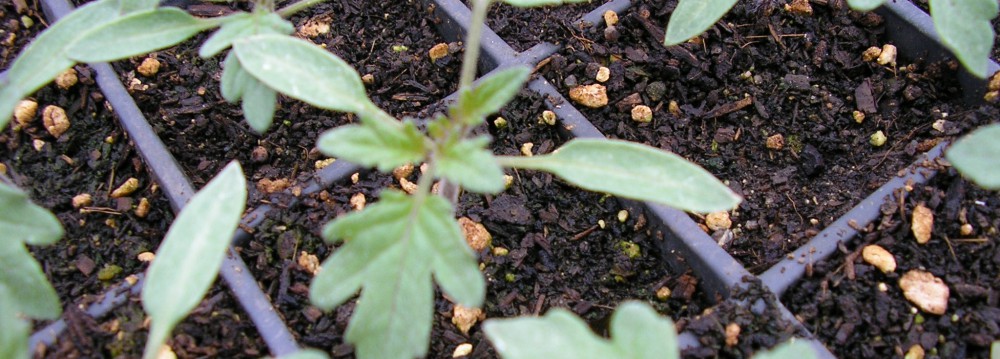
Once we the pumpkins finished up we went to the south field and planted 1200 F2 tomato, pepper, and eggplant plants that were grown out of seeds that were saved from hybrid varieties last year. Most hybrids are a cross between two inbred parental lines. The hybrid is the F1 generation. If you save seeds from the hybrid, the resulting plants are an F2 generation. Not all of them look like the original hybrid or either of the parents. We will pull out all the plants that don’t look like the F1 hybrid and will save the seed from the survivors. The idea is to create a good, stable, open pollinated variety that cannot be dropped by the seed industry.

It is interesting that seed saved from Early Girl, a 1962 All American Selection winner (now owned by Monsanto), produced just about exactly 25% potato leafed plants. This is interesting on two levels. 1) 25% is what you would expect from classical genetics and 2) all potato leaf tomatoes that I know of are heirlooms or very near crosses with heirlooms ( Brandywine comes to mind). We planted the potato leaf F2 Early Girl in a group by themselves to see what they will do.

Planting lettuce, basil, and the second round of zukes and cukes was hit or miss with the rain. I think everyone is tired of getting rained on…

Besides transplanting, we have been hard at it cultivating with the tractor and hand hoeing the tens of thousands on onions. My new least favorite weed is Yellow Nut Sedge. It is a yellow, grassy looking plant that has a three sided stem. It does grow from seed, but the seed is not very viable. There are two real problems with it. One is the tubers ( the afore mentioned nuts) that it forms as the plants mature. The tubers can sprout three or four times, producing a new crop of weeds each time. If yellow nut sedge is allowed to grow, the plants form a dense sod that is very difficult to till out.
I have decided to delay the start of our CSA for a week. The cool wet spring has not been good growing weather. Tonight we had our first salad out of the field. Needless to say, we have not been doing any wholesale vegetables yet. Usually we have a few weeks of harvests before we start up the CSA. Not this year. The CSA will run a week longer at the end so the season will still be 18 weeks.

We are down to our last three cabbages in the root cellar. Onions ran out this week. There are still a few carrots and beets, and we are dangerously low on pickled hot peppers. It is time to get some fresh veggies going.

This has been a challenging start to the year and I suspect that we will not get a ‘normal’ growing season out of this. It’s not alarming, I think this variability is what we have to adapt to to succeed here now. I expect the future will be a bumpy ride. Hang on.

Greg


May 19 Newsletter

Riverbend Farm Newsletter                                                 May 19, 2013


It has been a busy couple weeks.

 The regularly scheduled crop mob for the last Saturday in April was postponed due to snow and generally wet conditions that had kept us out of the field. The following week it rained Friday night and was cold Saturday morning.  We canceled that one. 

 Our crew was looking at planting 50,000 onions by themselves. Luckily Sam was back in town, and Jacob and Jordan were starting.  They began planting on Tuesday and got their system worked out. On Wednesday morning Jonathon, Mark, Mary and Max, Nate (yes, that Nate (he even biked out from Mpls for old times sake)), and Susan came by to help with planting. We planted something like 32,000 onions that day. Clearly a case of kicking ass and taking names. Carmen came by after work and gave everyone a boost when it looked (accurately) like there was no end in sight.

On Thursday Andrew, Jacob, Jordan, Noelle, and Sam planted about another 24,000 or so onions. They were moving. On Thursday I had committed to picking up a couple Allis Chalmers All Crop Combines and did not do any planting. On Friday Mary and Max came back, Georgina and Mette came and helped us finish up.  Mary and Max are long time CSA members and have been to more crop mobs than I have. Tracy is the only person who has come to more crop mobs than Mary and Max, but she couldn’t make it on Friday. She did send salads and bread for lunch, but we went to Dave’s to celebrate the end of onion planting. Thanks Everyone!

 Over all we have planted something like 75,000 onions this year.  I was planning on about 50,000, but honestly, did not count the seeds when starting them in the flats. Usually onions germinate at about 70-75%. This year every seed must have come up.  Noelle  thought that the planting had gone so well since she had been planting onions for 72 hours straight. She dreamt about planting onions for two nights.  Sam also was dreaming of planting onions.  As you know, Mary is a psychotherapist, so I think they will be okay. Eventually.

 Last Sunday morning it was cold. We had about 28º at the house. It must have been colder in the field because a lot of the kale turned yellow. The lettuce that was planted down slope (in a theoretically colder spot) looked fine. Lots of people had frost damage on their brassicas that night. It was a little unusual since kale is very hardy. I think that most of it will recover.  On Monday morning we had frost again and on Tuesday both of our thermometers that were in the shade showed 100º.  This is a strange spring. 

We haven’t had any real rain since the last heavy wet snow. From Friday into Sunday morning, we have had about 3 1/8 inches of rain. That much at one time will slow things down a little next week, especially if we get more rain in the next few days.  Sandy soil can have its problems, but it drains very well. We will be in better shape than the farms on heavier soil..

 This week was a big one for transplanting lettuce and brassicas into the field and  repotting tomatoes, eggplant and peppers in the greenhouse.  I’m kind of dragging my feet on setting out the warm season crops. It has been a record cold  (not to mention generally weird) spring and I’m not convinced that the weather will settle down next week. The traditional Memorial Day will be soon enough.

 Not to mention that if we get more rain in the early part of the coming week we will be out of the field until it dries out a little.  I like to wait as long as possible to do our spring tillage to give the winter cover crops time to grow and produce as much organic matter as they can.  It is nice to get the cover crops turned under a week to ten days ahead of planting so that the first flush of weeds will come up and we can kill them without having to worry about our vegetable plants being in the way.  This year the rye is only about 6-8 inches tall. In the past it has been 4-5 feet tall by this time of year. The dry weather last fall slowed it down.

 Everyone has been getting introduced to cultivating, plowing, and disking. Jordan grew up on a dairy farm in Wisconsin so he has an advantage when it comes to operating the tractors and an implement. Sam does pretty well also. He has driven tractors, but has no experience with field work. The controls are where they are and do what they do, so no problem. Andrew and Jacob have quite a bit of experience with newer tractors and equipment and have a conflict where a lot of what they know is wrong when it comes to my old equipment, but they adapt pretty quickly. Noelle has no experience driving tractors, but is willing to try and does okay. More experience driving tractors would make it easier..

  Yesterday was the first day for the Downtown Delano Farmers Market. Mary got that market started last year and suggested that I do vegetable transplants for the first few markets. So we loaded plants in the pouring rain, set up in a downpour and actually had a pretty good day, considering the conditions.  Farmers markets are a lot of fun. 

 We will have plants there for the next couple weeks. I was planning on two weeks, but with the cold wet start this year, three weeks might be better. If you are interested in garden plants we will have the following. If some of them are unfamiliar and you want more information on what they are like, send me an email and I’ll send you a list with descriptions.:

 Cherry Tomatoes: Sunsugar,  Peacevine,  Juliet, Montesino, and Fargo 

Standard Reds: Chianti Rose, Martian Giant, Jet Star, Paragon, Dakota Sport

Yellow/Orange: Orange you Glad, Amber

Roma type: Orange Banana, San Marzano, Amish PAste, Granadero, Viva Italia

Heirloom: Paul Robeson, Cherokee Purple, Brandywine, Persimmon, Evergreen, Uncle Everett, Pineapple, Black Krim, Prudens Purple

Sweet (mostly bell) peppers: Olympus, King of the North,  Revolution, Carmen, Flavorburst, Sweet Sunrise

Spice peppers: Boldog, Aji Dulce

Hot peppers: Habanero, Jalapride, Jalapeno, Super Chili, Hungarian Hot Wax, Hinkelhatz, Hot Cherry, Ancho

 Eggplant: Classic, Beatrice, Orient charm, Orient Express, Nadia, Clara, Nubia

 Brassicas: Nash’s Red Kale, Lacinato, Rainbow Lacinato,  Lech Kohlrabi, Early Jersey Cabbage,  Red Jewel

 We will also have a  selection of flowers, herbs, onions, and lettuce

 The market is on River St in Downtown Delano on Saturdays from 9 until 1.

 Greg

ps Next crop mob is Saturday June 1st. We will be planting tomatoes.


Riverbend Farm Newsletter                                                 May 4, 2013


We are going to need some help this week planting onions – see below.

 It has been an interesting couple of weeks.

 You might have heard about the snow they just got south and east of us. Yuk.  When the weather was warm, the frogs were singing and there were even a few swallows around. The maples and popples are starting to flower. The river is going down a little. It never got out of its banks this year, but it was right to the top.

 We have mostly missed out on the last two snows.  We got enough to make the grass white from the first one. The second one missed us completely.  Nice. In addition to being wet, the snow cools the ground down to 32º and brings all the microbial activity to a halt. Soil takes longer to warm up and dry out after a snow than when it rains. Of course the soil has to dry out before it can be worked.

 The day after I sent out the last newsletter we woke up to no water. We had electricity, but the water was not running.  There  was power at the Start and Run  terminals on the motor controller, so it seemed like the pump was dead. A call to our local well company had a guy ( Jim) here in a few hours.  He checked a few things,  pulled out the old pump and replaced it with a new one. $1200. Turning  on the power did not result in any water.

 There was water coming up alongside the well casing, which was a bad sign. It was getting late so we just ran a  garden hose from the down pipe to an outside faucet and still didn’t have any water. The  inlet line from the well to the house had to be disconnected to make everything work. The water was coming in and going right back out.

 The thought was that the hubless connector had failed so we had to dig down to find it. Andrew, Noelle, and I took turns digging and eventually found the connection without cutting off the electric line to the pump. The digging resulted in a hole that was seven feet deep and about five feet across. Throwing the dirt out of a hole like that is harder than you would think.  A couple days later Jim was back and discovered that the plastic line to the house had become brittle and snapped off.

 Every valve in the house was put off by the change in the system. I don’t know if it was the increased pressure or that sand had got in due to the broken pipe, but the toilet fill valves, the water heater temperature/pressure valve, the shower, the water softener, etc. were all dysfunctional.  And every old fitting leaked.  But it is sure nice to turn on a faucet and have water come out.

 About the same time, my computer went on strike. It was so slow. The Norton Anti Virus was coming up with errors and it turns out that there was some virus  slowing the system down. Needless to say, Norton AV is not running on my computer at this time. The new computer shop in Delano found and fixed the problem for $60. Seemed like a good deal to me. The owner (Ken) and his wife are opening a wine bar in Delano. Brave souls.

 We did actually do some farming when we had those few nice days last week. Most of the snow had melted and I was able to get in with a disk and work up a little ground for lettuce and kale transplants and  some direct seeded arugula and radishes.  By about Monday the arugula had come up.

 On the downside, the deer have already found the lettuce and started eating it.  Usually they won’t touch it until it is almost ready to harvest. And once they find a source of food, they return to it. I may have to move the lettuce patch and cover it until I get the netting for the ten foot fence.

 I also managed to get some oats and peas planted. Part of them will be harvested for seed and part will be a green manure crop. The overwintered kale, beets, turnips, and radishes that are being grown for seeds were planted on Monday and by Friday some of them were sending up seed stalks. A few of the buds are turning yellow, getting ready to open. Jean Peterson is growing the brussel sprouts for seed. Jerry Ford has the cabbage, and Amelia is growing the Lacinato kale and red beets.

 It will be very interesting to see how this works out.  Usually the plants that are overwintered are started in late summer. I think that would be a good idea since most of the old leaves rot in storage and the smell of rotting cabbage is not good. The younger plants are also supposed to overwinter better.

 Onions

I’m in a bit of a jam with planting onions. We were going to have a crop mob last Saturday, but Friday was the first time I could get in the field here, not to mention that I had been planning on putting them in at Cathy’s. Her fields are even wetter than ours and the road over to her place washed out. That’s is another story.

 The April crop mob was postponed to this Saturday, but the rain Friday night and this morning made it too wet to plant. The temperature has gotten up to 36º by noon and it is a little breezy. Not prime conditions for crawling around on cold wet ground planting onions. The crop mob for today has been canceled.

  With the crop mob there are 20 or so people who plant and we get a lot done in a hurry. That is not happening with onions this year. We will start setting them out next week with just our crew. And then there are the 10,000 tomatoes, peppers, and eggplant that need to be repotted since they will be going out at the end of the month…

  If you are not busy on Wednesday the 8th,  we could use some help planting onions.  If you are interested, send me an email.

  Thanks

  Greg

  ps  Carl Blanz at Three Crows is looking for an apprentice cook to work with him and  learn the restaurant business. Carl and Gina are taking Three Crows to the next level are venturing farther into sourcing local food.  If you know someone who might be a good candidate or might be interested, have them give Carl a call 763-972-3399.


Riverbend Farm Spring Newsletter

Riverbend Farm Spring Newsletter                                                April 14, 2013

The temperature had worked its way back to normal for a few days. The snow was all gone except for the plow piles, a little fringe along the edges of the windbreaks, and on the north side of the buildings. The frost went out about a week  ago and all the standing water in the fields disappeared. The blackbirds and geese are back.  The juncos are forming flocks, getting ready to head north. We are getting a few April showers, mostly in the form of snow.

 As much as I don’t care for this snow, the wet weather could be a sign, we are  coming out of the drought a little. The ground is still thawed so most of this moisture will soak in and help replenish the subsoil moisture. This spring is a little on the cold side, but less than 10 years ago it was unheard of to get into the fields before the middle of April. I won’t be seeding anything by April 15th this year.  Last year I planted on March 19th and we know how that turned out. Who knows, maybe peas will have a chance this time.

 We had a  couple pallets of seed potatoes show up Thursday afternoon. Our road had not been plowed and the truck driver would not come down it, Noelle, Andrew, neighbor Marty and I unloaded 4800 pounds of seed potatoes on the shoulder of Hwy 12. Most of the potatoes are going to other farms in the area and they too were having issues ( township didn’t plow to collecting sap from 2400 taps) dealing with the snow.  There are a ton of potatoes sitting in my garage.

Voles have been getting in the greenhouse, eating seedlings. Jimmy and Heather are starting some of their plants here and the voles especially liked their spinach and broccoli. They also ate some of my lettuce and about 120 pepper plants that were going to be transplants sold at the downtown Delano farmers market. So far I have caught five and have been working on finding and filling the holes where they were getting in.  Pesky things.

 Before the potatoes arrived Andrew, Noelle, and I pulled the cabbage, kale, and brussel sprout plants out of the root cellar and moved them into the greenhouse. The plants need to warm them up, get used to the light, and get ready to be transplanted back into the field for seed production.

 Most plants in the cabbage family are biennials, it takes them two years to produce seeds. There are turnips, swiss chard, two kinds of beets, misato rose radish, three kinds of kale, brussel sprouts and cabbage. The cabbages were covered with a thick layer of slimy leaves, but some of them are starting to split open and send out a seed stalk.

 Overwintering biennials for seed production is a bit of an experiment. The chard did not survive very well. Everything else look great, discounting the slimey leaves.. The crates that Amelia and I packed  the roots and plants in last fall are too big. They are really heavy. I will have to find foster  farms for several of the varieties so they don’t cross pollinate. Turnips, cabbage, kale, and brussel sprouts will all cross with each other. It will be interesting to see how this works.

 Mary has been busy filling up the greenhouse with marigolds, zinnias, morning glories, and sunflowers  that the grandkids are  going to sell at the market next month. I’m not sure what they think of that but Mary seems to be having a great time.

 Lately she had been driving my Honda since I have been working on her Volvo.  It  was due for a timing belt and a water pump. Not big jobs, but important ones. If the timing belt breaks or the tensioner fails, it wrecks the valves in the motor, to the tune of about $1200 in parts.  And she’s stranded. Not good. The oil seals on the end of the cams are leaking and as long as I’m in there…

 The  timing belt kit that is supposed to fit, according to the VIN number, didn’t.  The cam seals may be the same size or they may be two different sizes. This engine has continuously variable valve timing (VVT) on both the intake and the exhaust cams. The hubs of the cam drive sprockets contain the VVT units and they have to be removed to replace the seals.

Volvo did not put a keyway or pip on the end of the cams to locate the hubs so they have to be placed just so, adjusted, and bolted on really tight. Otherwise it will set a Check Engine Light or bend the aforementioned valves.  A complicating factor is that the dual VVT hubs have a different  adjustment procedure than the more common single VVT engine, and there is no publicly available factory service manual for these cars. The aftermarket service manual does not mention the dual VVT set up.

 For the time being, I’m going with the fact that the seals aren’t leaking much, and oil is cheap. I need to find the tools to hold the cams and  figure out the proper procedure for setting the cam timing with the dual VVT set up.

 The dog is still with us. She has settled down a lot, but she needs a job. She does not like guys in trucks. Her previous owner was an over the road truck driver and I wonder if he was mean to her. Everything is new for her and when the ice went out she was very curious, hanging over the riverbank looking at the water. Of course she fell in. Good thing dogs can swim. She is still fascinated with the water. Now se goes down to where the bank is lower to look at the water.

 Unfortunately, I don’t think she is going to be the great rabbit hunter I had hoped for. She does get them to freeze, but when they run she tries to head them off and round them up rather than just chasing them. Next month Jerry Ford is taking his dog (one of Allie’s pups) for an evaluation to see if it has herding instincts. I may take Allie  too and see if she a knack for that.  

 This week we are going to start repotting in earnest and seeding tomatoes. Summer is coming.


Greg


Greg


Early Spring Newsletter

It is meteorological spring and astronomical spring is not far off.  The days are getting longer faster. The sun is higher and warmer even if the air is cold. It is warm enough to melt the ice even when the air temperature is 20ºF . Birds are starting to sing in the morning. The swans are moving around. Believe it or not, winter is coming to an end.

The best thing is that we seem to be moving into a wetter weather pattern.  A lot of the moisture in the snow will run off since the ground is still frozen.  Looking at the soil temperature plots at the UofM’s St. Paul Campus, the soil below 20 inches is thawed. Above 20 inches it was thawing, but the past few days have pushed it below freezing again. If the soil thaws before the snow melts, some of the moisture will soak in and help recharge the subsoil. Even the runoff will help refill the rivers, lakes, and marshes. The National Weather Service is not predicting flooding in Delano this spring.

I fired up the greenhouse last week. The water heater that I use for a heat source does not do very well with the high humidity and being shut off for 8 months out of the year. Corrosion and mice are big problems. Mice are the worst. This unit has a ‘sealed’ combustion chamber, except the inlet air vents are just exactly mouse sized holes. Needless to say, they have filled the inlet air vents with milkweed fuzz, water heater insulation, etc. So now it is working with an unsealed combustion chamber.

The heater is big enough to keep the greenhouse at least 40ºF when the outside temperature is 20º F ( the normal high is 39º and the normal low is 20º at this time of year). When it is below zero in the morning it is a little touch and go. I have turned the heater up all the way and am putting two layers of row cover over the onion flats to keep them from freezing.  Elliot Coleman claims that he can keep things from freezing at -15º F in an unheated hoophouse with two layers of row cover. I wonder what I’m doing wrong…  Actually, I think he is full of it.


This year I’m seeding about 60,000 onions. Germination rates are typically 70% so the actual number of plants will probably be 25% more than last year. The big increases are in cippolini and shallots. They both store very well and we always run out long before they start to go bad.

There are also some great storage varieties. Dakota Tears ( from Prairie Road Organic Seeds) and Redwing keep very well. The Dakota Tears are all gone, but they were rock hard right to the very end. Some of the reds are getting a little soft. Some drying out is to be expected, they were harvested 6 months ago.

Seeds are mostly on hand. Another order, of hybrid tomato and pepper seed, should arrive today.  I’m hedging my bets on the saved seed a little bit. It is unlikely that all my big red tomatoes had crossed with the cherries and produced a bunch of junk, but it will be interesting to see if there is a noticeable difference between the seeds that have had a chance to become a little adapted to our conditions. Speaking of saved seeds, the kale and cabbage plants in the root cellar are looking a little sad.  I’m sure that they will survive to produce seed, but it would be nice to set them outside on nice days to get them some sun and fresh air.  That’s unlikely to happen since the crates full of damp dirt are very heavy.

Mary is involved with the Delano Food Council and is busy planning for this summer’s Downtown (Delano) Farmers Market. It is a great little market, right by the river, with grass, shade, a cafe, etc. I’m going to be selling vegetable transplants at the first two markets in late May. If you are interested in garden plants, send me an email and I’ll send you my variety list.  I’ll be offering a 10% discount to our CSA members.

Big news on the CSA front – FruitShare prices are in. Prices are about 11% higher than last year due to uncertainty in how the weather will affect production.  Most of the farmers that Everett is working with were reluctant to commit to prices at this point. It must be really hard to have one crop and count on it.

One project that I am getting involved in this year is the Genetically Modified Organism (GMO) Labeling effort.  You know that GMOs are not allowed in organic production. But beyond that, I’m suspicious of chemicals and technology in our food. I grew up in an era when DDT was perfectly safe and there were no geese.  Or Eagles. Or hawks, etc. Randomly changing the genetic make up of our food plants is also supposed to be perfectly safe.

As always, the trouble is that the safety testing ( and the approval process ) is pretty weak. Long term GMO safety tests usually last for 90 days and are run by the chemical company that produces the product. The companies also prohibit  use of the seeds for research, making it hard for anyone whose school or institution depends on chemical companies for funding, to verify those results.  The real long term feeding studies that have been done, and the rise in food related allergies do not make me feel any better about GMOs. I think that a sensible first step is to label food that contains GMOs.

I don’t want to eat them and should be able to find out if the ‘natural’ crackers are made with GMO corn or soy products. This seems like a perfect argument for conservatives and libertarians. The lack of knowledge is causing a breakdown in the free flow of information that is required for a free market to function. If there is no market for a product or it is unsafe, it should disappear.

It is interesting, when I talk to student groups I ask them questions. How many of you eat an organic food diet. A few raise their hands. How many of you eat Genetically Modified food ? Even fewer raise their hands.  What are the rest of you eating ? About 80% of the corn and soy used in conventional ( and probably natural ) food is GMO. How may of you have food allergies ? Typically 10% or so raise their hands. When I was a kid there was maybe one kid in our class (or 800 or so ) who was lactose intolerant. It is not hard to find statistics on the increase in food allergies back up my anecdotal observations.  What happened ?

Industry arguments against GMO labeling are:

It costs too much

Everyone knows that the box costs more than the corn flakes in it.  Farmers get about 5% of the retail processed food dollar, so roughly speaking, a $5 box of corn flakes has about 25¢ of corn in it ( Farmers Union claims 13¢ ) . If the cost of producing non GMO caused the price of corn to double (unlikely), the price on a box of corn flakes should go up 25¢.  Something tells me it is not the cost of the corn that is driving the price of cornflakes.

Labeling would be easy. Any product that contains any commodity crop could safely be assumed to contain GMOs since 75% or corn and 90+% of soybeans are GMO. The next time they print a new batch of corn flake boxes they could just add ‘Now with MORE GMOs!’ to the graphics.  I’d even bet that they could get activists to label all the packaged food in grocery stores for free.

We need to feed the world

This sounds good, but has been basically hogwash for 40 years. Most of the world’s poor are subsistence farmers who feed themselves. Besides, no one sits down to a big plate of corn and soybeans for supper. These crops are industrial inputs or livestock feed.

A related argument is that GMOs produce better and they use less chemicals. More baloney. GMO crops don’t yield better than their conventionally bred counterparts and they don’t use less pesticides and herbicides. Actually they have created resistant weeds and pests that require more applications and more toxic chemicals. Long term studies of organic crops show that they produce as well as GMOs  in most years and better in drought conditions.  GMOs were widely accepted because they were an easy way to make the fields look better. Farmers everywhere look at  their neighbors fields and say, ‘That’s a nice looking crop’ or tsk-tsk over the weeds that show up in the row.  It’s cultural.

No negative health effects.

It is hard to find problems if you don’t look. Most of the safety studies were done by the chemical companies promoting the GMOs and they were only done for 90 days or so. Longer term studies are not so sanguine about the health effects. Your immune system reacts to novel proteins. GMOs obviously contain novel proteins. Why wouldn’t your immune system react to them ? Allergies ? Hmm.

No market

This is a big one. They say that if GMOs were labeled, no one would by them. Well, duh. Right now, no one believes that they are eating GMOs, and they don’t want to. Surveys report that something like 90% of people want GMOs labeled.

It seems reasonable that it would be a problem for processed food makers if labeling GMOs means that no one wants to eat them and there wouldn’t be any market for products that contain GMOs. But that is the way the ‘free’ market is supposed to work.  Theoretically,  markets work best went the buyer has enough information to make informed buying decisions. Funny, but the corporate captains of industry can be against transparency in the marketplace. They may have reached a point where profit is the most important thing to them. That is a problem. If the buyers don’t want a product, why make it ?

I don’t want to eat GMOs in my natural crackers. Let me know and let me decide..

Visit www.righttoknowmn.org and stay informed on this issue.

Rant off.

Greg

Riverbend Farm Winter Newsletter                         January 16, 2013                 


People ask ‘What do you do in the winter ?’ Well, there’s maintenance, various projects, conferences,  and little down time.  My maintenance and project list is pretty long, but I have been making some progress. It seems that there are farming conferences every week, sometimes two a week, from the first of the year until March. A few of them are: CRSFA chapter Sustainable Farming Assn. meeting,  the Minnesota Organic Conference, Midwest CSA conference, state SFA, Midwest Fruit and Vegetable Growers, MOSES Organic Conference, Farm to School …  


This winter I have been doing a papermaking internship at Cave Paper in Minneapolis. They do handmade paper, mostly from flax, but using several other fibers too. The paper usually goes to bookbinders and artists.


Paper is something that I have had an interest in for a long time, but never really did anything with it. Last summer at the Seed Savers Conference  there was a book on making paper from garden plants. It caught my eye and I read it cover to cover pretty quickly. 


Cave Paper was mentioned in the book and when I looked at their website it said they did internships, but not in the winter since they didn’t have any heat. I figured that it can’t be any worse than washing turnips when it is 40º, so why not? It has been very interesting and I’m in the process of making paper out of corn husks.  


 I’ll use headings for the various sections so you can skip the ones that are simply of no interest. And, If you have no interest in getting these newsletters, please let me know, I’ll take you off my list.


The Farm


As you know it was very dry going into this fall. It was do dry last fall that a lot of the cover crop seed never emerged. Hopefully it germinated and will come up this spring. Some of the snow that we received did melt and I think that it soaked into the ground.  That helps, but we are still about a foot short on moisture. Now that the surface is frozen it is sealed off until the ground thaws in the spring. Making up a foot shortfall will be tricky without flooding,


Even if the drought continues into next spring, there should be enough soil moisture to get a crop of oats and peas planted. The green manure sorghum will be a little more touch and go since it is a warm season grass that will need rain to get it to germinate. Once it gets established, sorghum is actually somewhat drought tolerant


The cover crop is more of a concern than the vegetables.  The veggies are going into ground that has had two years of green manure crops and with drip irrigation there will be plenty of water for them. The fertility for next year and the year after would be most affected by severe drought this year.


I think that I have figured out a work around for the bacterial spot on arugula. As you remember, for the past few years we have had an enormous problem with bacterial spot wiping out our greens and radishes. 


Trying to breed it for resistance is tough. The conditions usually aren’t right for the disastrous spread of the bacteria until July. Not every plant becomes infected, some have a natural resistance to the bacteria. If the resistant plants are moved to a nursery bed, they can be grown out for seed. The problem was that last summer it took forever for them to go to seed once they were transplanted. None of them made it.


No one else seems to have this problem. What are they doing differently ? They are covering their arugula to prevent flea beetle damage. Flea beetles are not a problem for us so I don’t use row cover. Covering the arugula prevents the wind and rain from spreading the bacteria from plant to plant  during storms.


At a CSA conference last week one of the workshops presented some ideas on working  more efficiently. One of those ideas was a way to remove row cover (the pieces are typically 10’ X 300’) from the field without shredding it. It also makes it easy to reinstall the row cover. If the row cover can be secured to stay in the field during storms, this could be a solution.


We had a tremendous corn crop last year and have lots of corn for cornmeal. Besides offering it to restaurants, I have been test marketing it at a few local stores around town. You can find one pound bags of Riverbend Organic Cornmeal at Mississippi Market on West 7th, Linden Hills Coop, the Wedge, and at Three Crows here in Delano.


Website


This story starts back in late June when Apple unceremoniously pulled the plug on their webhosting service. Early July is a bad time to find a new webhost and figure out how to get our website working again.


I have been working on getting a new webhost and website sine mid November. Right now it is sort of functional. I need to update the content for 2013, but so far so good. It took forever to get through all the IT Speak to get the domain transferred to out new webhost. Now the www address works again,  and I don’t have to make changes to all the directories that list our website. The program that makes the webpages is all new and it is taking some time to figure out how everything works. Hopefully FruitShare prices will be updated in the next week.


Dog


We got a new dog. Allie is a rescued border collie. Border Collies have a reputation for being high maintenance, but this one has been pretty good. Allie was abandoned about the time she had a litter of puppies, so she had to fend for herself and the puppies.  She and the puppies wound up at a friend of ours in Buffalo. I have been kind of looking for a dog and here was an opportunity.


When she got here she was pretty depressed. A abandoned, moved, new people, moved again, no puppies, no other dog. Big changes. For some reason she bonded to me. She was like a duckling, following me everywhere I went. Crate training ? forget it. She does not like being confined. She doesn’t even like being in the house, but with separation anxiety she does not like to be outside alone. So she is always pestering me to go outside. Even if it is 10º with a 15 mph west wind.  Allie loves to 1) run, 2) hunt mice, 3) chase rabbits. She has some unsavory habits from her days on her own. It will be interesting is she loses her taste for carrion as time goes by. Giving her beef bones was not successful. She just buries them. Same with rawhide chews. She buried one in my closet.


Not knowing what to do with her when I went some where, I put her in the back (she does not like riding in cars either) of my Volvo wagon. I thought that I would try her out by going to the local coffee shop and sitting where she could see me. Bad idea. I thought that she was pawing at the window. She was shedding the door card and the interior of the car.  She is better now. Mostly she just sits on the driver’s seat and looks out the window or sleeps.


Soon enough I have to go to a CSA conference in Eau Claire and Mary has to keep Allie by herself. That night I call home and there is no answer. I try several times and still no answer. “That’s odd” I think, but maybe she went to Jennifer’s. I call again in the morning and there is no answer on either phone. I’m a little concerned, but it is probably nothing.


I left the meeting a little early and driving home I start thinking about what could have gone wrong. ‘The dog bit Mary’, ‘The dog ran away and Mary is out looking for her’. There are all manner of things that could have happened, but you know that usually it is a minor problem like the cell phone is dead or something.


When I got home my wagon was gone, as was Mary and the dog. The paper and the mail were in the house. There were no bodies or blood. Actually everything was pretty neat. I figured if something happened, Mary did it and that she was okay.


Well, the first morning Mary’s schedule was a little off kilter dealing with the dog and all. Mary has a few clients to see, gets to the building and realizes she forgot the key. Her first client is waiting, but she has to go home and get the key. After a few sessions, she realizes that she has lost the key to the car. The dog is locked inside, but asleep on the seat. Mary has lunch with her friend and gets are ride back to the house and gets a spare car key.


That night Mary decides to let the dog out for a run before bed  and as the door clicks shut behind her, she remembers that she had locked the door and is stuck on the porch in her pajamas. Luckily there was a blanket in her car and a pair of boots one the porch. All the windows and doors are securely locked so Mary trudges over to the neighbor’s in the rain with the dog. Doug was very surprised to see her.


Mary gets a ride over to Jennifer’s (with the dog) and spent the night on the couch. Mary gets the Olivia and Emma off to school and  the kids were excited to walk to the bus stop with the dog.  Jennifer’s neighbor gives Mary a ride home and she waits for the locksmith to come and let her into the house. .


Equipment 


The delivery van started using a little coolant last fall. There was never a puddle under it, but it smelled like antifreeze. The engine is a GM V6, which are notorious for leaky intake manifolds and head gaskets. Four out of six cylinders were sucking in coolant. It is easy to tell with the heads off, the combustion chambers are clean and the exhaust valves have a green tint. Without taking the engine apart you can tell by looking at the spark plugs, they have a green tint.


Replacing the head gaskets was uneventful. It took a few days of work, and $60 worth of parts. The head gaskets claimed to be a “No-Retorque Design’. When  head gaskets are replaced, the bolts that hold the cylinder heads on are tightened to a specified torque (turning force) value to give a uniform clamping pressure across the cylinder head.


On tractors, and certainly my Norton, after the bolts are tightened the first time, the engine is run until it gets up to temperature, it is allowed to cool, and the bolts are tightened again. The heating and cooling cycle compresses the head gasket a little and reduces the clamping pressure of the bolts. The reduced clamping pressure can cause the gasket to leak prematurely.


The “No-Retorque Design “ is supposed to eliminate that second tightening. And as it turns out it is BS. After I ran the motor in the van and let it cool off, the bolts under the exhaust manifold had ‘loosened’ by 15-20%.  They clearly needed to be retorqued.  I’ll save the tirade on shortcuts for later.


All the trucks and tractors needed an oil change.  In the process of changing the oil I look over each vehicle to see what else needs doing. One tractor needed the oil pan gasket replaced. The pickup needed  a U-joint and the muffler and tailpipe.  Not too exciting but better now than mid August.


The Farmall 350 needs to be taken apart again to see why the Torque Amplifier (an extra low gear for the transmission) is not working. I bought the tractor knowing the T/A was out and had installed a new T/A and clutches  this spring. It was never right. The T/A clutch was completely bound up and could never release.  Obviously, something is wrong. The tractor is barely 55 years old, but the rear tub, the back part that holds the transmission, differential, etc. had been replaced with one from a later model ( that should be backwards compatible ). I suspect that the problem is in there, but I’ll need a 350 tub to measure to see if that is really the case.


For fun I bought a ’67 Volvo station wagon (P220) . It is in pretty good shape, but it needs a little TLC before it will be up to the task of pulling Mary’s little camper this summer. It has an aftermarket  Weber  carburetor that needs to be rebuilt. It is a little gummed up and the jetting needs to be sorted out.


This car has an early dual circuit master cylinder that was used for a few months as a stop gap measure in late 1967. They are very obsolete  and there are no parts for them. The brakes work fine, but of course sinks a little a little when you just hold your foot on the brakes. A classic symptom of a master cylinder on its way out.  Rumor has it that a rebuild kit from an early Volvo 140 has the same rubber parts. This will probably be a little more of a project since the brakes will need to be bled after the master is rebuilt. I suppose there is a chance that the bleeder screws will open rather than snap off.


I  have a perfectly good Allis Chalmers 72 combine that does a reasonably good job harvesting dry beans. It could be improved with a  draper header and a grain pick up. A draper is a wide canvas belt that carries the cut crop from the sickle section up to the threshing cylinder. The 72 has a auger in the head that shells out some of the beans and they never even get into the machine. The draper will reduce those losses.


A grain pick up will take windrows of beans off the ground and put them on the draper. In the past, we have made windrows by hand by pulling the bean plants and  piling them between the rows. A neighbor in Maple Plain, Bob Volkanant came up with an idea for using cut out disks on a couple hydraulic motors to cut and windrow the beans. Another project…


A guy in our SFA chapter had three Allis Chalmers All Crop combines ( you can see pictures at http://www.allcropharvester.com/ , look at the All Crop Overview in the header bar). I wanted to buy the one of them for the draper style header. I wound up with all three.

So Far So Good

As you may have noticed the www address is working again. I still need to figure out if I can put up more pictures than just the tomato seedlings. There is a new page that lists the plant varieties that I used last year.  This year’s varieties will be a little different, but they won’t be set until early June. The FruitShare prices are not finalized yet. Everett is still waiting to hear back from a  few of the farms he works with.  Next week -

I might like the blog part of this new site. Once CSA sign ups were done, there was not much happening on our website. This way newsletters can be posted here and people other than CSA members and customers can read about what is happening on the farm.


I wonder how this works

Welcome to our new website, I think. It looks like our web address went from www.rbfcsa.com to http://rbfcsa.com.  I’ll need to fix that. And figure out how to put some farm related pictures up instead of the random ones that show up now.  Please consider this version 0.5…


If you mouse over the “Welcome” heading above, you will find a drop down list of CSA related content. The pages are out of order and not exactly up to date (no fruitshare info, no update on last year, etc.). CSA prices are the same as last year and the starting and ending dates should be correct.


Greg